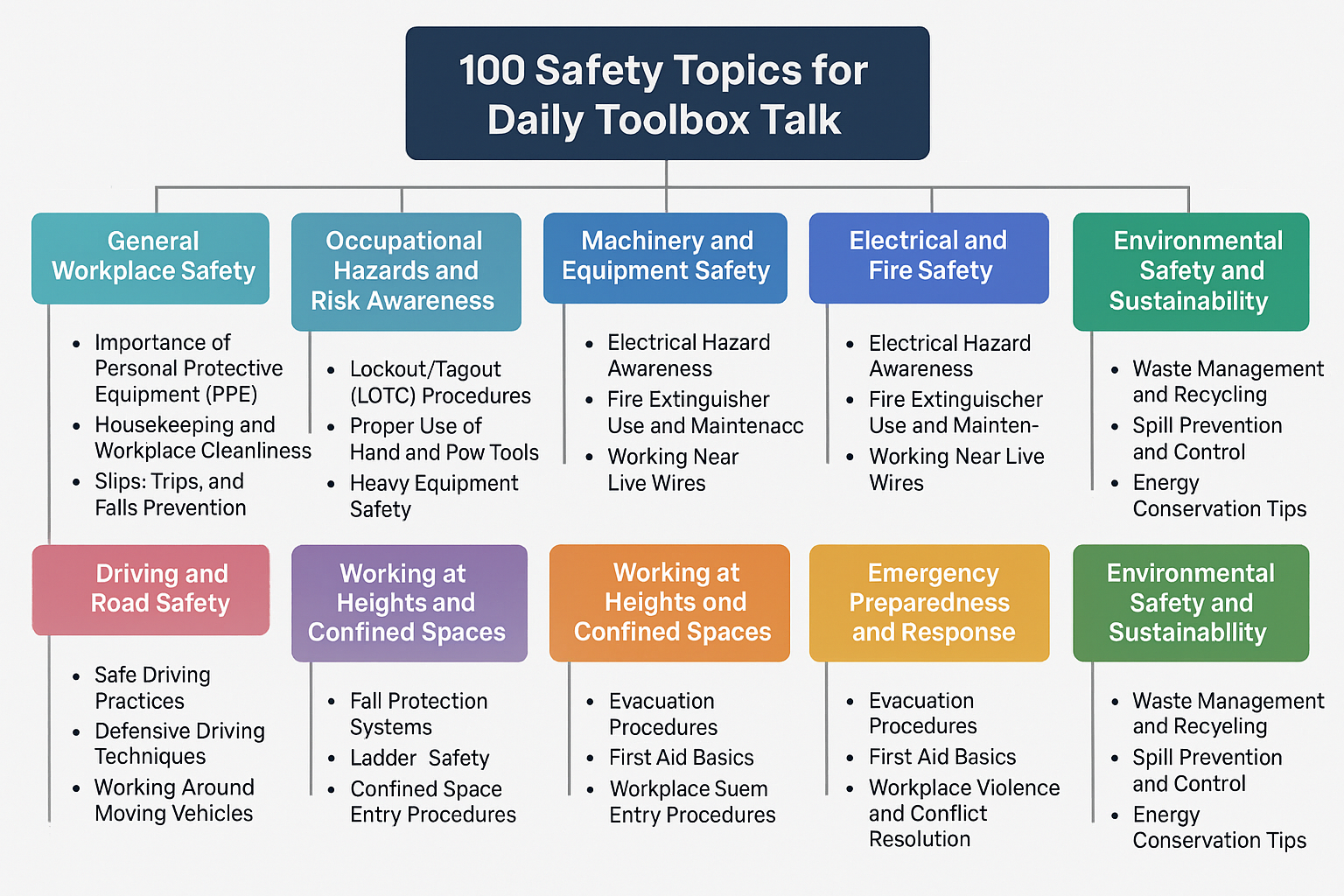
Workers rush onto job sites every morning with tools in hand, hard hats on, and safety briefings often treated as a box to check. But when those briefings lack relevance, engagement, or variety, they lose their power. That’s where a curated list of 100 safety topics for daily toolbox talk PDF becomes a game-changer—transforming routine meetings into impactful safety rituals.
A well-structured toolbox talk PDF isn’t just a checklist. It’s a living document that addresses real hazards, adapts to changing conditions, and keeps crews alert. Whether you’re a safety manager, foreman, or operations lead, having a ready-to-use bank of 100 topics eliminates guesswork and ensures compliance while fostering a proactive safety culture.
Let’s break down how to build, use, and sustain a toolbox talk program that actually works.
Why 100 Topics? The Power of Consistency and Variety
Repeating the same safety talk every week breeds complacency. Workers tune out. Hazards evolve. Seasonal risks like heat stress or winter slips demand fresh attention. That’s why 100 safety topics matter—they provide enough depth to cover every corner of job site risk without recycling content too soon.
Think of it like a safety curriculum: - Weekly rotation? 100 topics last over two years. - Daily talks? Run 20-week cycles with seasonal refreshers. - Project-based? Pull relevant topics for each phase—excavation, roofing, electrical rough-in.
Without variety, even the best-intentioned talks become background noise. With a diverse bank, you can align topics to: - New equipment on site - Weather changes - Incident trends - Regulatory updates (OSHA, ANSI, etc.)
Real example: After a near-miss involving a forklift, a site manager pulled "Pedestrian Safety Around Heavy Equipment" from their 100-topic PDF—turning a scare into a teachable moment.
What Makes a Good Toolbox Talk Topic?
Not all topics are created equal. A strong daily safety talk should be: - Specific – Not “General Safety,” but “Safe Ladder Use on Uneven Ground” - Actionable – Ends with clear takeaways: “Inspect ladder feet before each use” - Time-efficient – 5–10 minutes max - Visual-friendly – Works with photos, diagrams, or live demos
Weak topics fail by being too broad or theoretical. “Hazard Communication” is vague. “Reading GHS Labels on Paint Thinners: What the Pictograms Mean” is not.
A solid 100-topic PDF includes: - 30% general safety (PPE, housekeeping) - 40% task-specific (welding, scaffolding, confined space) - 20% environmental (heat, cold, weather) - 10% behavioral (fatigue, distraction, situational awareness)
This mix keeps content fresh and directly tied to real work.
Top 10 Must-Have Safety Topics in Your PDF
Even with 100 topics, some are non-negotiable. These are the anchors of any effective toolbox talk program:
- Proper Use of Hard Hats and Eye Protection
- Common mistake: Wearing hats backwards or using scratched safety glasses.
- Fall Protection at Heights
- Use case: Daily review before rooftop work begins.

- Lockout/Tagout (LOTO) Procedures
- Critical note: 120+ LOTO-related fatalities occur annually in the U.S.
- Hazard Recognition: The 5-Point Scan
- Workflow tip: Train crews to scan for slips, struck-by, caught-in, falls, electrocution.
- Safe Use of Extension Cords on Site
- Limitation: Most outdoor cords degrade in 90 days—check insulation weekly.
- Fire Extinguisher Types and Use (PASS Method)
- Demo idea: Practice with a training extinguisher monthly.
- Noise Exposure and Hearing Protection
- Fact: Prolonged exposure above 85 dB damages hearing permanently.
- Hand Safety: Avoiding Crush and Cut Injuries
- Real risk: Glove misuse—some gloves don’t protect against sharp blades.
- Situational Awareness in High-Traffic Zones
- Tip: Use the “3-Second Scan” rule before moving equipment.
- Emergency Evacuation Routes and Assembly Points
- Best practice: Mark routes on site maps and verify access weekly.
These topics form the backbone. The remaining 90 expand into specialized, situational, and often overlooked risks.
How to Turn 100 Topics Into Actual PDFs
You can’t just list 100 titles and call it a PDF. A useful document structures each topic for quick delivery.
Each entry should include: - Topic title - Key hazard(s) - Discussion points (3–5) - Real-world example or near-miss - Action items (what to do today) - Optional: QR code linking to video or OSHA standard
Example Entry:
Topic: Working Alone: Staying Safe Off the Radar Hazard: Delayed emergency response, lack of oversight Discussion: - Check-in procedures every 2 hours - Use GPS-enabled radios or apps - Never skip PPE—even when no one’s watching Near-miss: Worker collapsed in a utility closet; discovered 4 hours later Action: Assign a buddy for solo tasks, even if remote
Use templates in Word or Canva to keep formatting clean. Export to PDF for universal access—no edits possible, version-controlled.
5 Popular Tools to Generate or Customize Your PDF
You don’t have to build from scratch. These tools help create, manage, and distribute your 100-topic PDF:
| Tool | Best For | Key Feature | Limitation |
|---|---|---|---|
| SafetyCulture (iAuditor) | Digital delivery | Pre-built toolbox talk templates, PDF export | Subscription model |
| SmartSafe | Customization | Topic library + AI suggestions | U.S.-focused content |
| EHS Insight | Compliance tracking | Integrates with training records | Steep learning curve |
| ClickSafety | OSHA-aligned content | 100+ ready-to-use topics | Less visual appeal |
| MakePDF Toolbox Talk Generator | DIY users | Free downloadable templates | Minimal branding options |
Pro tip: Use one of these to generate drafts, then customize with your site-specific risks, photos, and protocols.
Common Mistakes That Undermine Your Toolbox Talk PDF
Even the best PDFs fail when used poorly. Watch for these pitfalls:
- Reading verbatim: Workers zone out. Use the PDF as a guide, not a script.
- Ignoring engagement: Ask questions. “Has anyone here seen a frayed extension cord used?”
- One-size-fits-all: Roofing crews don’t need trenching talks. Rotate topics by crew.
- No follow-up: If you discuss ladder safety, spot-check ladders that day.
- Buried access: If the PDF is in a shared drive no one checks, it’s useless.
- Better workflow:
- Download weekly topic from master PDF
- Add site-specific details (e.g., “Today’s lift plan at Grid C”)
- Print or display on tablet
- Lead talk, assign safety observer
- Log attendance and action items
This turns a static document into a dynamic tool.
Seasonal and Situational Topics
You Can’t Afford to Skip
A strong 100-topic list doesn’t ignore time-based risks. Include:
- Summer: Heat stress signs, hydration breaks, UV exposure
- Winter: Ice prevention, layering for warmth, battery performance in cold
- Rainy season: Slip resistance, electrical safety on wet surfaces
- Night shifts: Fatigue management, visibility with headlamps
- Project phase: Confined space entry during commissioning, crane ops during steel erect
Real use case: A crew in Texas added “Hydration and Buddy Checks in 100°F Heat” after two workers showed early heat exhaustion signs. The talk led to mandatory water breaks—no more incidents.
Making It Stick: Culture Over Compliance
A PDF full of 100 topics is only as good as the culture it supports. The best programs do three things:
- Empower workers to lead talks – Rotate facilitators weekly. A laborer discussing hand safety brings credibility.
- Tie topics to real events – After a spill, talk about proper cleanup and reporting.
- Review and refresh – Every 6 months, update the PDF. Remove outdated topics. Add new risks (e.g., drone use, EV charging stations).
When workers see their concerns reflected in the talks, they engage. When talks feel like a formality, they don’t.
Final Thoughts: Your 100-Topic PDF Is a Living Tool
A 100 safety topics for daily toolbox talk PDF isn’t just a checklist. It’s a strategic asset—designed to prevent injuries, reinforce training, and build a safety-first mindset.
Start with a solid list, structure each topic for impact, use digital tools to simplify delivery, and never stop refining. The goal isn’t to check a box. It’s to start every shift with clarity, focus, and a shared commitment to going home safe.
Download. Customize. Print. Talk. Repeat.
FAQ
Where can I find a free 100 safety topics for daily toolbox talk PDF? Several EHS websites offer free templates—OSHA’s site, NASP, and safety blogs. Verify content matches your industry.
How often should I rotate through the 100 topics? For daily talks, use a 20-week cycle with 5 topics per week. Revisit high-risk topics quarterly.
Can I customize a toolbox talk PDF for different crews? Yes. Create versions for electricians, operators, and laborers—each with role-specific topics.
Should toolbox talks be signed off? Yes. Attendance logs prove compliance during audits and after incidents.
What’s the ideal length for a toolbox talk? 5 to 10 minutes. Focus on one clear hazard and 2–3 actionable takeaways.
How do I keep workers engaged during talks? Ask questions, use real examples, rotate facilitators, and encourage crew input.
Are digital toolbox talk apps better than PDFs? Apps offer tracking and analytics, but PDFs work offline and require no login—ideal for remote sites.
FAQ
What should you look for in 100 Safety Topics for Daily Toolbox Talk PDF Guide? Focus on relevance, practical value, and how well the solution matches real user intent.
Is 100 Safety Topics for Daily Toolbox Talk PDF Guide suitable for beginners? That depends on the workflow, but a clear step-by-step approach usually makes it easier to start.
How do you compare options around 100 Safety Topics for Daily Toolbox Talk PDF Guide? Compare features, trust signals, limitations, pricing, and ease of implementation.
What mistakes should you avoid? Avoid generic choices, weak validation, and decisions based only on marketing claims.
What is the next best step? Shortlist the most relevant options, validate them quickly, and refine from real-world results.